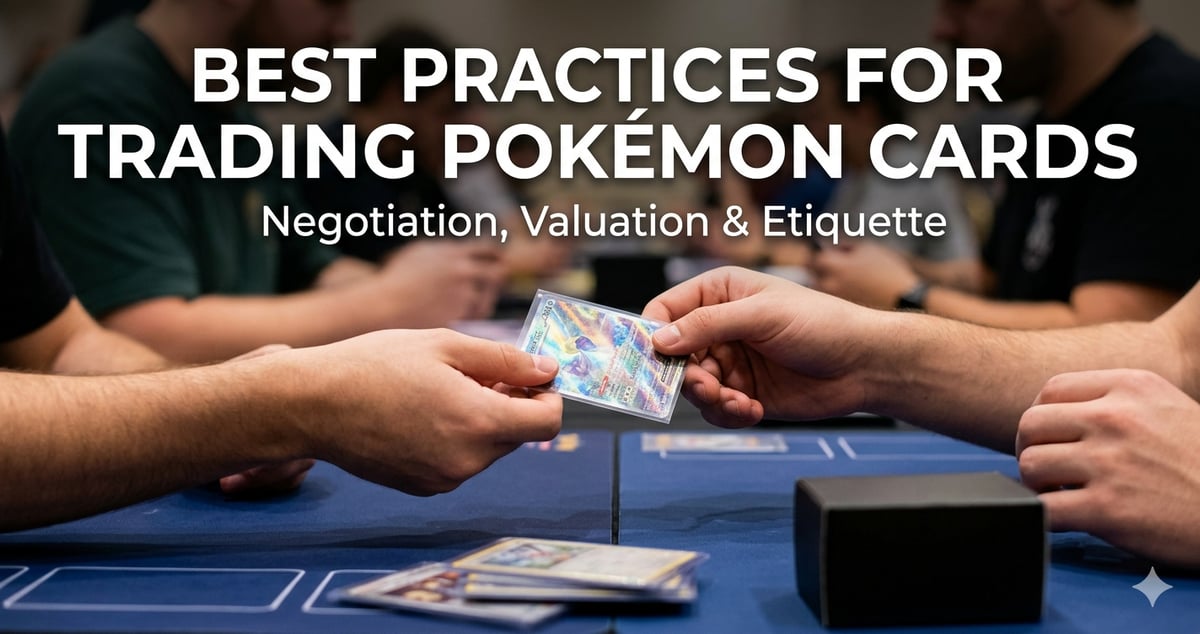
Trading is where the real Pokémon card community lives.
Buying happens on marketplaces. Selling happens at auctions. But trading? Trading happens between collectors who understand each other's needs, who know how to value fairly, and who've built reputations that open doors.
Whether you're swapping cards at a local league, negotiating trades on Reddit, or completing sets through Discord communities, how you trade determines what you get. The best traders consistently extract 15–20% more value from their collections than those who simply buy and sell.
This guide teaches you the professional trading practices that turn you into the collector everyone wants to trade with.
The Foundation: Know Your Card Values
You cannot negotiate a fair trade if you don't know what your cards—and theirs—are worth.
Where to Get Current Pricing
Primary sources (use at least two):
- Cardmarket — The European standard for market pricing, with real transaction data
- TCGplayer — North American pricing benchmark with daily updates
- eBay Sold Listings — Actual completed sales, not asking prices
- PSA Price Guide — For graded cards specifically
The method: Look at the last 10–20 completed sales for the specific card and condition. Throw out the highest and lowest outliers. The middle range is your fair market value.
Example Valuation
You want to trade a Mega Charizard ex SAR from Perfect Order:
- Cardmarket: last 10 sales range €85–€120, average €98
- TCGplayer: last 10 sales €88 – 121, average €100
- eBay: last 5 sold listings €84 – 116
Fair trade value: approximately €95–€105 / €93 – 102
When someone offers you cards totaling that range, you know it's fair. If they offer €60 in value, you know they're lowballing by 35–40%.
Trading Rule #1: Understand Card Tradability
Not all cards at the same price are equally valuable in trades. Some cards are "liquid" (easy to trade again), while others are "sticky" (hard to move).
High-Tradability Cards (Accept Slight Discounts For These)
- Iconic Pokémon: Charizard, Pikachu, Mewtwo, Rayquaza in any set
- Competitive staples: Cards actively played in Standard format
- Recent chase cards: SARs and MURs from the latest 2–3 sets
- Graded cards PSA 9+: Universal demand across markets
Low-Tradability Cards (Demand Premiums For These)
- Niche Pokémon: Obscure species with small fanbases
- Rotating format staples: Cards about to leave Standard
- Foreign language singles: Unless specifically sought by a buyer
- Bulk rares: Cards with market value under €2–3
The rule of thumb: When receiving high-tradability cards, accept values up to 5% below market. When receiving low-tradability cards, insist on 10–15% above market to compensate for the difficulty of moving them later.
Trading Rule #2: The Art of the Opening Offer
How you start a negotiation determines where it ends.
The "Anchor" Technique
Never make the first offer unless you're prepared to anchor high.
If you're proposing a trade, start by offering slightly less than fair market value (5–8% less). This creates room for negotiation while still being reasonable enough that the other party engages.
Bad opening: "I'll trade my €100 card for your €100 card straight up." (No room to negotiate, feels rigid.)
Good opening: "I'm looking at your Mega Rayquaza SAR. I've got a Mega Charizard ex and a Pikachu promo—interested in discussing?" (Open-ended, invites dialogue.)
The "Package" Strategy
Individual card-for-card trades often stall because values don't align perfectly. Package trades solve this:
- Offer bundles: "My three cards (total €85) for your two cards (total €90)" gives the other party a slight perceived win
- Include sweeteners: Throw in a common foil, a promo, or an energy card to bridge small value gaps
- Balance eras: Mix vintage and modern cards to appeal to different collecting styles
Trading Rule #3: In-Person Trading Etiquette
Local leagues, tournaments, and conventions are where the best trades happen—but only if you respect the unwritten rules.
The Do's
- Bring a trade binder organized by type, set, or value tier
- State your wants upfront: "I'm looking for Mega Evolution SARs and WOTC holos"
- Handle cards with clean hands and ask permission before touching
- Use sleeves and top-loaders for cards during the trade discussion
- Confirm values together using phone apps before finalizing
The Don'ts
- Never pressure someone who says "let me think about it"
- Don't disparage card condition to manipulate value ("this has whitening, I'd say it's MP")
- Don't flash high-value cards to attract attention then refuse all offers
- Never trade with minors without a parent/guardian present
- Don't finalize trades then try to renegotiate after the handshake
The "Show and Tell" Method
The most successful in-person traders follow this sequence:
- Show your binder and let them browse freely
- Ask what they're interested in (don't push specific cards)
- Ask to see their binder and identify your wants
- Propose a trade verbally with rough values
- Pull up pricing together on Cardmarket or TCGplayer
- Agree or counter-offer once
- Finalize with a clear exchange and both parties confirming satisfaction
Trading Rule #4: Online Trading Safety
Online trading introduces risks that in-person trades don't have. Follow these protocols:
Platform Selection
| Platform | Best For | Risk Level |
|---|---|---|
| Reddit (r/pkmntcgtrades) | Established community, reference system | Medium |
| Discord servers | Fast trades, niche communities | Medium-High |
| Facebook Groups | Large reach, varied experience levels | Medium-High |
| TCGplayer/Cardmarket | Protected transactions | Low |
Safety Checklist for Online Trades
- Check references: On Reddit, require 10+ confirmed trades for valuable cards
- Use tracked shipping: Always. No exceptions for cards over €20
- Take timestamped photos of every card before sending
- Agree on shipping method before finalizing (who pays, which carrier)
- Lower-value sender ships first: Standard practice—the person with fewer confirmed trades or lower-value cards sends first
- Never send to an unconfirmed address or use unconventional payment methods
Red Flags to Watch For
- New accounts with no trade history offering premium cards
- Pressure to skip normal safety steps ("just send it, I'll send mine tomorrow")
- Refusing to provide close-up photos of card condition
- Wanting to trade exclusively through DMs instead of public threads
Trading Rule #5: Building Your Trading Reputation
Your reputation is your most valuable trading asset. It takes months to build and minutes to destroy.
How to Build Reputation Fast
- Start with small trades (€10–€30 value) to accumulate confirmed references
- Always ship within 24 hours of finalizing a trade
- Over-protect your shipments (double-sleeve, top-loader, rigid mailer, tracking)
- Confirm receipt promptly and leave positive feedback
- Be honest about condition — describe flaws before the other person notices them
The Reputation Compound Effect
After 20+ confirmed trades with positive feedback:
- Higher-value traders will initiate trades with you
- You gain "ships second" privilege (lower risk)
- You get access to private trading groups with premium inventory
- Your trade offers are taken seriously immediately
Advanced Strategy: Trading for Portfolio Growth
Smart traders don't just swap cards—they use trades to strategically grow their portfolio's value.
The "Trade Up" Method
Convert several lower-value cards into one higher-value card. Higher-value cards tend to appreciate faster and are more liquid.
Example: Trade 5 cards worth €20 each (€100 total) for 1 card worth €90–95. You've concentrated value into a more liquid, appreciating asset.
The "Set Completion" Arbitrage
Complete sets are worth more than the sum of individual cards. Trade for the final cards you need to complete a set, then sell the complete set at a premium.
Timing Trades Around Releases
- Before set release: Chase card values are highest (hype-driven)
- 2–4 weeks post-release: Prices dip as supply floods the market (buy/trade for)
- 3–6 months post-release: Prices stabilize at true collector value
Looking for more ways to maximize your collection's value? Read our guide on Pokémon Card Collection Tips and learn How to Spot Fake Pokémon Cards to protect yourself during trades.
Read Next
- The Beginner's Guide to Pokémon Card Collecting in 2026 — Start with the collecting basics
- Pokémon Card Collection Tips: Build Your Collection the Right Way in 2026 — Smart strategies for growing your collection