


Major Pokémon TCG era transitions start with a trademark filing.
When The Pokémon Company registers a new name with the Japanese Patent Office, it's not random. These filings are the earliest public signal of what's coming, often six to twelve months before an official announcement. Over the past decade, trademark analysis has become one of the most reliable prediction tools available to collectors and investors.
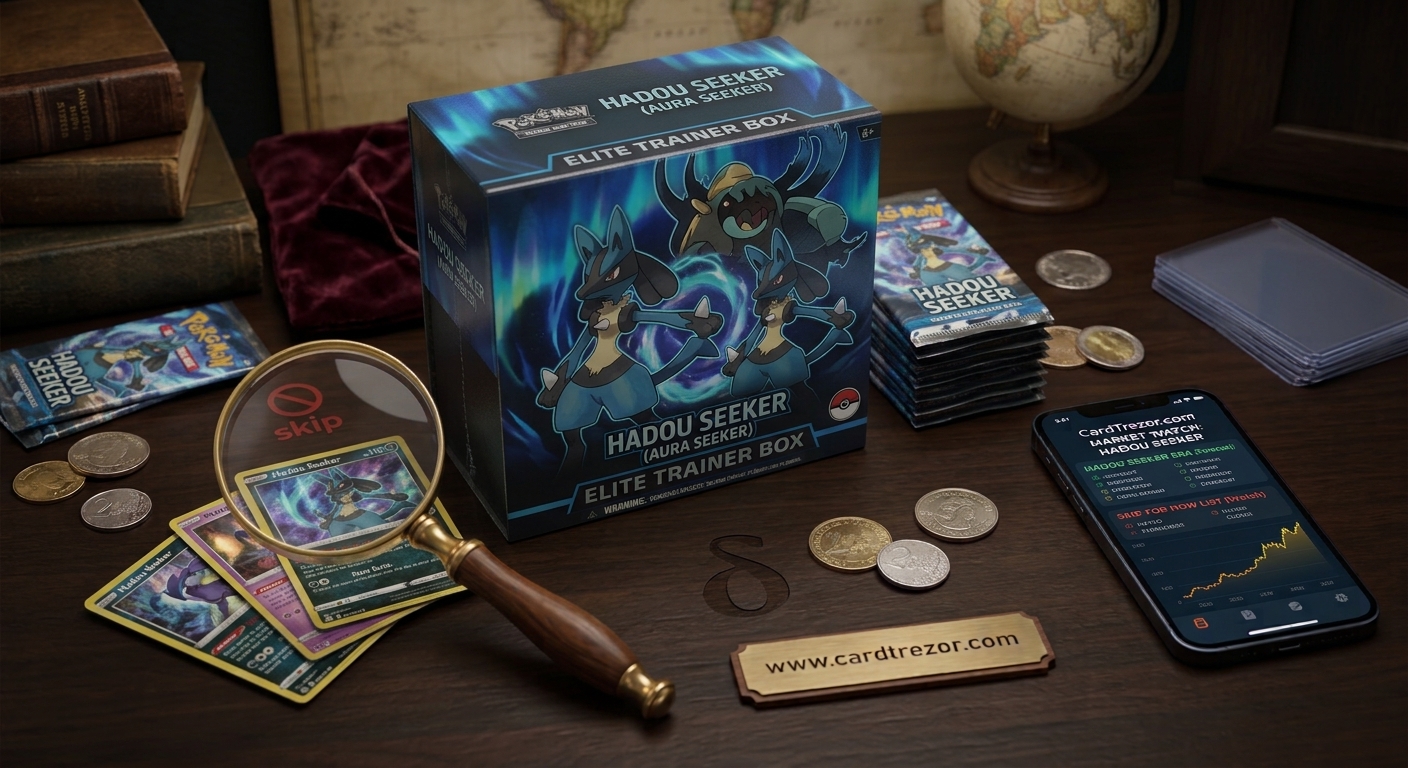
The newest case study landed on March 10, 2026: "Hadou Seeker" (ハドウシーカー), filed by Nintendo, Creatures, and Game Freak under the same product classifications used for past TCG set names. PokeBeach surfaced it within days, and English-language coverage quickly settled on "Aura Seeker" as the rendering. Same filing, two names.
Our read: this is a Lucario set, almost certainly headlined by Mega Lucario Z, with a reported Japanese release on November 27, 2026 and an English version likely in early 2027. That gives you a concrete window to position your portfolio.
How Trademark Filing Predicts Pokémon TCG Sets
The method is simple: find the filing, read the name, map it against the release calendar.
The Pattern Is Consistent
The Pokémon Company follows a predictable filing cycle. Trademarks for set names, expansion codes, and even product lines typically appear 6–12 months before the Japanese release. By tracking these filings, collectors have successfully predicted dozens of upcoming sets.
Notable examples from recent eras:
| Trademark | Surfaced | Set Name | What Happened |
|---|---|---|---|
| Crown Zenith | Q4 2022 | Crown Zenith (SWSH12) | Final Sword & Shield set, massive chase card market |
| Paldea Evolved | Q3 2022 | Paldea Evolved (SV2) | Scarlet & Violet's second expansion, Iron Hands ex era |
| Obsidian Flames | Q1 2023 | Obsidian Flames (SV3) | Introduced Terastal mechanic to TCG |
| Shrouded Fable | Q2 2023 | Shrouded Fable (SV6) | Smaller expansion, Pecharunt chase card |
One honesty note: these dates mark when the community spotted each filing, not necessarily the legal filing date. For prediction purposes, discovery date is what matters.
And the pattern holds for Hadou Seeker. Filed March 10, reported for November 27. Roughly eight and a half months, right in the middle of the historical window.
Where to Find Trademark Filings
Serious collectors watch the Japan Patent Office (JPO) database and WIPO (World Intellectual Property Organization) for new filings. Sites like PokeBeach and community forums typically surface these discoveries within days. The filings are public record, and anyone can search them.
What makes Hadou Seeker noteworthy isn't just that it exists. It's how legible the name turned out to be.
Why "Aura Seeker" Points Straight at Lucario
"Aura" has one dominant association in Pokémon, and it wears a blue aura-sensing jackal's face.
The Meaning of "Hadou"
"Hadou" (波導) translates roughly as "wave guiding." In Pokémon lore it belongs to Lucario, who senses and manipulates this blue wave-like energy. The 2005 film Lucario and the Mystery of Mew (ミュウと波導のルカリオ) built its entire plot around the concept, and Lucario's signature move Aura Sphere is literally Hadōdan (はどうだん) in Japanese.
So the community didn't debate this one for long. Within days, every major tracker converged on the same conclusion: Mega Lucario Z, the first "Z" Mega Evolution, revealed through the Pokémon Legends: Z-A Mega Dimension DLC in December 2025.
A common mix-up worth killing: some collectors connected "Hadou" to Mewtwo via Psystrike. That doesn't hold. Psystrike's Japanese name is Psycho Break (サイコブレイク), which has nothing to do with hadou. The Mewtwo theory never survived contact with the language.
What "Seeker" Adds
The "Seeker" suffix stands out. It's not a common TCG set naming pattern, but it evokes exploration and discovery, themes that fit a post-anniversary era focused on new beginnings. Previous suffix patterns include:
- "Rising" (Chaos Rising): growth, emergence
- "Evolved" (Paldea Evolved): progression, transformation
- "Flames" (Obsidian Flames): intensity, power
- "Black" (Pitch Black): darkness, mystery
"Seeker" suggests a narrative of pursuit: hunting for something lost or hidden. Whether that signals a new mechanic tied to discovery or simply evocative branding, we'll know when the card list lands.
Investment Implications
Want a sense of how much demand a Lucario headline carries? Look at the 2020 Pokémon of the Year vote. Lucario finished second overall behind Greninja with over 102,000 votes, and won its home Sinnoh category outright. Few Pokémon combine that level of fan recognition with lasting competitive relevance.
Lucario cards have historically commanded premiums over comparable non-Lucario cards from the same set, and chase cards like Lucario VSTAR from Astral Radiance held value well beyond their release window. Mega Lucario Z ex enters with stronger baseline demand than most set mascots ever get. First-of-its-kind rarity treatment, top-tier character.
A Note on Dual Sets
One trademark, but could it hide two products? It has happened before:
- Battle Styles (2021) shipped internationally as a single set built on the Japanese Single Strike Master and Rapid Strike Master pair
- Scarlet & Violet introduced parallel paths with different Legendary focus
Still, the simplest read of a single filing under standard set-name classifications is a single main expansion, designated M7 in Japan's current block. Companion products historically get their own filings. Watch for a second trademark rather than assuming one exists.
What This Means for the Mega Evolution Era's Timeline
The trademark slots neatly into the endgame of the Mega Evolution era.
Are We Approaching an Era Transition?
The Mega Evolution era has been extraordinarily successful. From Chaos Rising through Storm Emeralda and the upcoming 30th Anniversary Celebration, the Mega Evolution mechanic has dominated competitive play and collector demand for over a year.
But eras don't last forever. Here's how the handover now lines up:
| Milestone | Date | Significance |
|---|---|---|
| Hadou Seeker trademark filed | March 10, 2026 | Earliest signal of what comes next |
| Storm Emeralda (M6) | July 31, 2026 | Final Mega Evolution-focused main set |
| 30th Anniversary Celebration | September 16, 2026 | Capstone event for the era |
| Reported Japanese release | November 27, 2026 | First post-anniversary main set (not yet officially dated in Japan) |
| Expected English release | Early 2027 | Unconfirmed; based on typical localization gaps |
This timeline makes sense. The Pokémon TCG typically transitions eras every 2–3 years, and a November flagship carrying a brand-new "Z" mechanic is exactly how a handover tends to look: celebrate the old era in September, open the new one before the holidays.
The 30th Anniversary as a Pivot Point
The 30th Anniversary Celebration on September 16 is the perfect narrative bridge. Anniversary sets historically serve as both a celebration of what came before and a preview of what's next. The 25th Anniversary (Celebrations, 2021) included reprints that hinted at where the game was heading. The 30th can do the same, closing the Mega Evolution chapter weeks before Hadou Seeker opens the next one in Japan.
Portfolio Positioning: How to Prepare
You don't need to wait for official announcements to act. The filing calendar has already told you where the market's attention goes next.
For Collectors
- Complete your Mega Evolution chase cards now: if the era is winding down, the window for acquiring key cards at reasonable prices is narrowing
- Watch for 30th Anniversary pre-orders: the Celebration set will likely include both Mega Evolution nostalgia and first looks at the next era's themes
- Track Japanese releases closely: the Japanese market typically reveals new era mechanics 2–3 months before the English release
For Investors
- Hold sealed Mega Evolution product: sealed product from the final sets of an era historically appreciates well as supply dries up
- Watch Mega Lucario Z singles early: with a Mega Lucario Z headline expected, first-wave SARs tend to be priced inefficiently in the weeks after the Japanese reveal
- Monitor Cardmarket price trends: use Cardmarket tracking to identify when Mega Evolution cards plateau (signal that the era transition is priced in)
What to Watch For
The next 3–6 months will be critical. Watch for:
- Official confirmation of the November 27 date from Japanese retailers and The Pokémon Company (Japanese outlets still treat it as unofficial)
- First card reveals (typically in the final 2–3 months before a Japanese launch, via CoroCoro and official channels)
- Cardmarket pre-order pricing for Japanese booster boxes: this is the earliest reliable market signal for new era demand
📊 Track set releases and card values with CardTrezor: the free portfolio tracker with live Cardmarket prices. Start tracking free
Read Next
- Storm Emeralda Preview: Mega Rayquaza ex, Split Stadium & Delta Reign (2026). The set bridging the current era to what comes next
- The Mega Evolution Era: What It Means for Collectors and Investors in 2026. Full context on the era this trademark may be ending