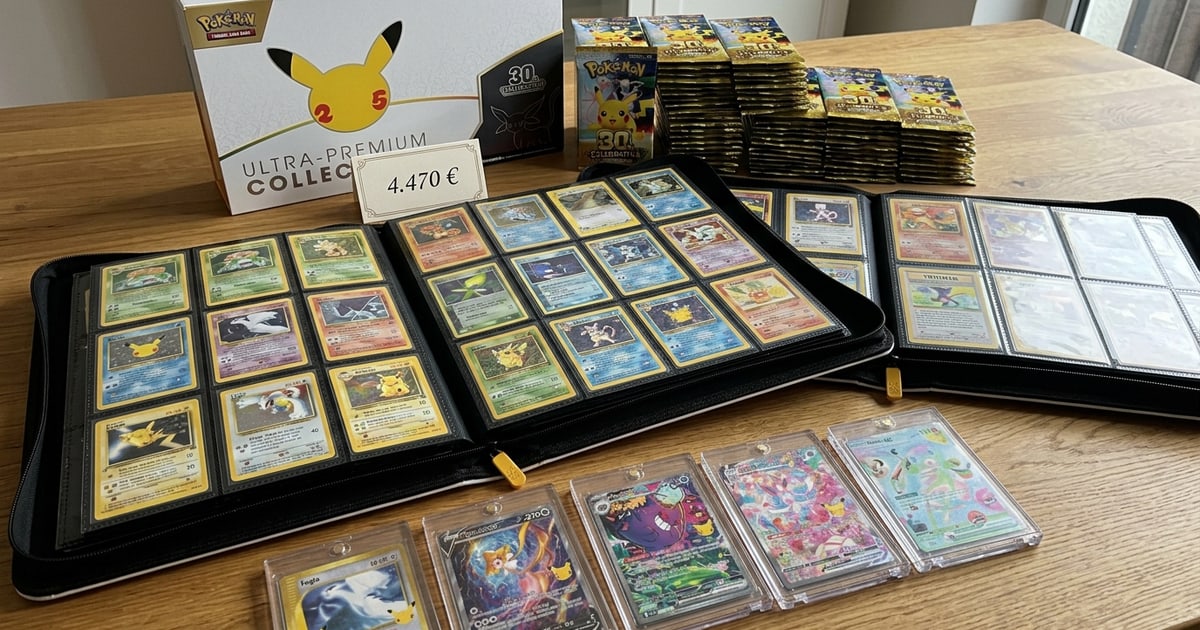
If you are working out the cost to complete a Pokémon set, 30th Celebration is an expensive one to finish. A complete master set runs about €4,470 in Europe on expectation, and about €5,590 if you want to be 95% sure you actually have it. The Elite Trainer Box the set is marketed through lists at $49.99 at US MSRP, holds nine packs, and gets you nine of the 199 cards you need.
The box math is wrong, and not because the box is bad. Completing this set is two separate problems with different prices, different timelines and different optimal buying strategies. The Pikachu subset is a coupon-collector grind you solve with statistics. We modelled both halves of this set against Cardmarket median offers from October 2, 2026, and the numbers below are what that model produces. The Classic Collection subset is a supply wall you solve with money, and no amount of pack buying gets around it.
What "Complete" Actually Means: 199 Cards
Thirtyth Celebration has 199 distinct cards. That is 161 numbered cards (128 base plus 33 secret and rare extras, numbered 129 to 161), plus the 30-card Classic Collection reprint subset, plus 8 foil Basic Energy. Every one of the 199 cards in the full set list has to arrive in your hands before anyone can call the set complete.
The pack does not distribute those 199 cards evenly. It distributes one thing perfectly: five foil cards plus one foil Energy, and exactly one of 30 unique Pikachu illustrations. Pokémon states that rule officially, which is why the Pikachu math below is a calculation rather than a guess. Everything else about a pack is a matter of luck, and the set is deliberately built so that the cheap tier (the Pikachus) is guaranteed while the valuable tier is not.
The Real Cost to Complete: Two Grinds, Two Prices
The 30 Pikachus cost roughly €1,870. One guaranteed Pikachu per pack, 30 equally likely illustrations, and the coupon-collector expectation is 30 × H₃₀ = 119.85. Call it 120 packs. At the 6-pack Booster Bundle on Cardmarket, priced at €93.51, that is €15.59 per pack, so 20 bundles and €1,870.20. At 95% confidence you need 189 packs, which is 32 bundles and €2,992.32.
The 30 Classic Collection reprints cost between €2,537.60 and €2,599.00. A dedicated Classic Collection pack holds three cards, so ten units is the mathematical minimum. At the €253.76 we observed per dedicated pack that is €2,537.60; at the €259.90 Ultra-Premium Collection route it is €2,599.00. Both figures come from the same October 2 snapshot, and the gap between them is the only part of this calculation you get to choose.
Add them and you get the number at the top of this article. On the Ultra-Premium route, 1,870.20 plus 2,599.00 gives 4,469.20, so about €4,470 expected; grinding the dedicated packs instead brings that leg down to 2,537.60 and the total to 4,407.80. That 61.40 euro spread is the one part of this calculation you actually choose. At 95% confidence the Pikachu leg rises to 2,992.32 and the same route carries you to 5,591.32, so about €5,590. Those euros are spent before a single graded card, shipping charge or binder enters the picture. US buyers should read the same structure in dollars on TCGplayer, where the market has settled much higher.
One assumption carries that total, and it is the weakest link in the model: it assumes the 33 numbered extras and the 8 Energy cards simply show up inside the packs you are already buying for Pikachus. That is unconfirmed. If they turn out to need dedicated buying, the real number is higher than €4,470, not lower.
Why 30 Packs Never Works
Buying Elite Trainer Boxes until you have thirty Pikachus means buying thirty packs, which is four ETBs. That plan fails on arithmetic alone. Drawing 30 unique cards in exactly 30 draws means hitting a specific permutation of all thirty, so the probability is 30!/30³⁰. That works out to about 1.3 × 10⁻¹², or roughly one chance in 770 billion.
Practically everyone who buys exactly 30 packs ends up without all 30 Pikachus. Not most people. Effectively all of them. Thirty packs costs about €468 at bundle prices, which makes it look like the cheap route, and it is how a lot of collectors end up with a half-finished subset they paid full price for. The median is 113 packs, and 99% confidence takes 237.
The rest of the pack is a separate gamble. A TCGplayer study of more than 3,000 packs put Illustration Rares at 1 in 5 and Special Illustration Rares at 1 in 21. The Futuristic Rare tier has no published measurement: roughly 1 in 130, unconfirmed. If the set's real value sits in SIRs and FURs, then pack rate matters more than pack count.
What the Secondary Market Actually Charges You
Europe is not paying MSRP for sealed product, and the useful detail is how tightly the markup clusters: a narrow band across every format, which rules out one greedy seller as an explanation. The Cardmarket 30th Celebration sealed listings reflect it:
| Sealed format | Median offer (Oct 2, 2026) | Per pack | vs US MSRP | US MSRP |
|---|---|---|---|---|
| Booster pack | €16.99 | €16.99 | 3.8x | $4.49 |
| Booster Bundle (6) | €93.51 | €15.59 | 3.5x | $26.99 |
| Elite Trainer Box (9) | €190.00 | €21.11 | 3.8x | $49.99 |
| Tech Sticker Collection (3) | €40.00 | €13.33 | 2.7x | $14.99 |
Each multiple is the euro median divided by the US MSRP in dollars, with no currency conversion applied. Convert the MSRP column at roughly 1 € = 1.16 $ and the band widens to 3.1x to 4.4x.
Per pack the line-up is not monotonic. The bundle undercuts the single pack, the ETB is the worst per-pack price, and the Tech Sticker Collection is the cheapest of all because it is a small sealed product rather than a booster format. What does not vary is the markup band, which holds between 2.7x and 3.8x on raw dollars whatever the format. That is why every figure in this article uses the Booster Bundle at €15.59 as its per-pack basis: it is the cheapest among the three booster formats, and a number a reader can reproduce beats one that shaves a few cents off the estimate.
The $49.99 ETB at 3.8x is the awkward line in that table, because the ETB is how this set is advertised and it is the worst per-pack deal on the shelf.
The top of the curve is already unwinding. On October 2 the one-day ETB median sat at €177.45, below both the 7-day average of €182.24 and the 30-day average of €183.31, and sealed trackers put ETBs down 23.2% over thirty days. That is the launch spike coming off, not a discount forming. Pay launch prices only if you need sealed product this month; if you can wait, let the Wave 2 restocks arrive first. Whether sealed value is worth chasing as an asset at all is a separate question, covered in our sealed Pokémon product investment analysis.
The one outlier on the upside is the $179.99 Ultra-Premium Collection, which holds 29 regular packs plus 1 dedicated Classic Collection pack. It trades at roughly 1.6x MSRP, with French retail at €259.90. It ships in Wave 4 on November 6, 2026, so on the date this article publishes it does not exist yet and every figure quoted for it is a preorder listing. That is still the format to watch, because it is both cheaper per pack and less inflated than anything in the booster line-up.
The Classic Collection Wall
The inversion here is that the 30 Pikachus are the least valuable segment in the set. TheHobbyBin puts them at under 1% of the tracked value across the whole release, on a tracker that counts 188 priced cards and excludes grading costs. They are also among the most expensive parts to complete. The Classic Collection reprints carry about 51% of that same tracked value.
So the cards you are grinding for are the cheap ones, and the cheap ones are the grind. The path to those 51% runs straight through the one product regular packs cannot supply. Classic Collection cards are rare in booster packs, not guaranteed, which means every extra booster bundle you buy to chase Pikachus adds almost nothing to the Classic subset. Ten Ultra-Premium Collections or ten dedicated packs is the floor, and there is no clever sequencing that lowers it.
That is worth $2,101 according to TheHobbyBin on October 1, and that number is the trap. It is the sum of currently listed single prices, so it is what the singles route costs if every reprint in the set were on sale at once. They are not, which makes the figure a floor rather than a plan. Read it as the cheapest conceivable outcome, never as a quote.
What to Actually Buy
Start at MSRP wherever you still can, because the reason so much of this set was bought at retail rather than at 3x is timing, and our 30th Anniversary preorder strategy shows how that played out across the release waves. With the secondary markup in the 2.7x to 3.8x range, retail is still the cheapest channel by a wide margin.
Then split your budget by segment instead of treating the set as one target. If you want the Pikachus, buy Booster Bundles and accept 120 packs as the real price, or hunt singles where they run €0.30 to €1.82 each on Cardmarket and grind out the gaps. If you want the Classic Collection, you are buying ten dedicated units, and regular booster bundles will not cover them. The full product line-up across all four waves is in our 30th Anniversary Celebration set guide.
If you want both, budget the two rows separately and set a cap before you open the first pack. Overcommitting to one grind is survivable. Finding halfway through that the other one was never budgeted at all is what turns a €4,470 project into a €7,000 one.
So is it worth completing a Pokémon set like this one? It depends entirely on which part you are chasing, and the two halves point in opposite directions. The Pikachus are not worth completing for value. They carry under 1% of the tracked value in the set, cost roughly €1,870 to finish, and any one of them is available as a €0.30 to €1.82 single on Cardmarket today. Buy those individually and treat the set as never finished. The Classic Collection is the part worth budgeting for, because it holds 51% of the tracked value and cannot be assembled any other way. The honest answer is no on the boosters and yes only on ten dedicated Classic units. Most collectors who finish this set do it for the binder rather than the balance sheet, which is a perfectly good reason as long as you know which one you are buying.
The Equipment a 120-Pack Grind Requires
Do the arithmetic before you buy anything. 120 packs is roughly 720 cards pulled, and you keep 199. At that volume storage supplies are part of the completion cost, not a hobby purchase, because the damage happens to duplicates you were planning to bin.
Start with somewhere for the 199 keepers to live. A toploader binder holds the finished set in one place, which is what makes a completion worth something later rather than a stack in a drawer.
 ProCase Toploader Binder for Trading CardsBuy on Amazon →
Then handle each pull as it lands. Sleeve it before it goes anywhere, because foil surfaces fingerprint and bend at the corner, and a bulk re-sleeve of 720 cards at the end of an evening is how corners get damaged. That includes the duplicates.
 Ultra Pro Penny SleevesBuy on Amazon →
Anything moving out of a penny sleeve and into the binder wants one more layer. Toploaders protect the 199 you are keeping from the friction of repeated handling and from the weight of everything stacked on top of them.
 Ultra Pro Card ToploadersBuy on Amazon →
And for the one that arrives with a crease from a bad pack opening, a repair kit beats binning a card you spent €15.59 to pull.
 SLEEVEE Card SaverBuy on Amazon →
None of that changes the €4,470. It changes how much of the 199 is still in good condition once you are done.
If you are still deciding which tracker to use, our best Pokémon card collection apps comparison covers what the free tier actually tracks.
Tracking a 120-pack grind by hand is how collections get lost. CardTrezor keeps every card, its price and your set progress in one place. Free to start.
Affiliate Disclosure: CardTrezor is a participant in the Amazon EU Associates Programme. We earn from qualifying purchases. This article contains affiliate links.
Read Next
- 30th Celebration Chase Cards: The 10 Cards Everyone Wants. Where the value actually sits, from the Palm Reader Mew down to the €0.30 Pikachus, with live prices
- Sealed Pokémon Products: Investment or Collection Filler. How to judge the ETB at 3.8x, and when a cooling market means waiting rather than buying