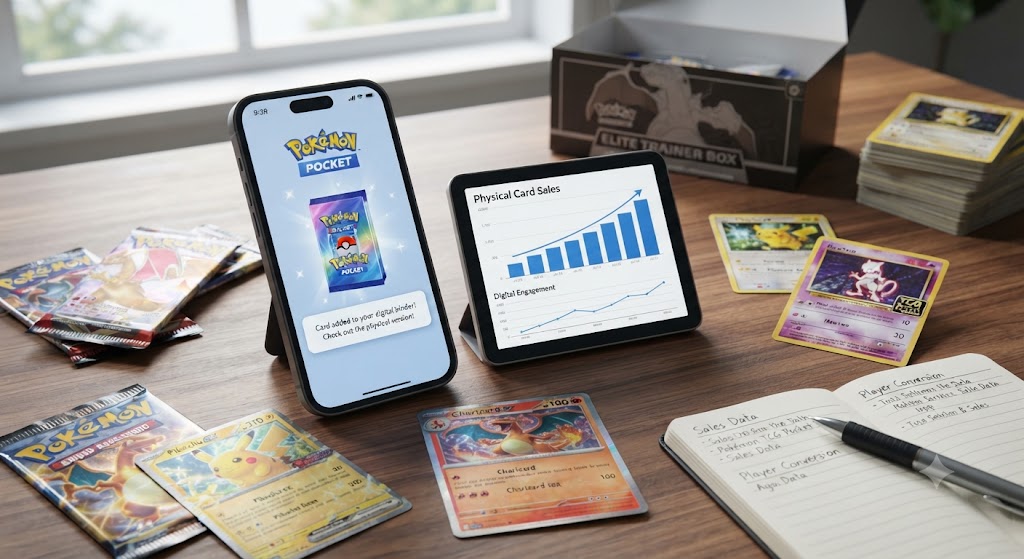
Pokémon TCG Pocket launched in late 2024 as a mobile game. Two years later, it is reshaping the physical card market.
The question every collector asks: does a free digital card game help or hurt the value of the physical cards sitting in your binder? We dug into Google Trends data, Cardmarket transaction volumes, and auction house results to find the answer. The data is clear, and it is more interesting than a simple yes or no.
What Pokémon TCG Pocket Actually Is
Pokémon TCG Pocket is a mobile game that launched in October 2024. Players open digital booster packs, collect digital cards, and battle with a simplified ruleset. It takes the pack-opening thrill of the TCG and strips away the competitive complexity.
The game hit 30 million downloads in its first month. On May 20, 2026, The Pokémon Company announced 200 million. Scale like that moves markets, because every one of those players is a potential physical card buyer. The daily card-flipping mechanic and pack-opening animations expose millions of people to Pokémon card art and collecting culture who would never have walked into a local game store.
The simplified format is key. Pocket uses fewer cards per deck, removes the energy system, and streamlines turn structure. Approachability is the point. It creates a specific pipeline: players who start digital and eventually want to hold real cards in their hands. As PokeBeach has covered extensively, the game's design intentionally mirrors the physical TCG's core appeal while removing friction for newcomers.
The Digital-to-Physical Pipeline: Evidence From Other TCGs
This pattern predates Pocket. Digital card games have pulled players into physical markets before, with unambiguous results.
Magic: The Gathering Arena launched in 2018 and became the primary way millions of people learned to play Magic. Hasbro's earnings calls after Arena's open beta repeatedly credited the digital client with lifting tabletop engagement, and paper Magic sales grew alongside it. Arena grew the player base. New players learned on Arena, then bought their first Commander deck or draft pack at a local store.
Hearthstone (2014) was digital-only, with no physical equivalent. But it created enormous demand for the physical Warcraft universe and helped establish the broader TCG/CCG market. Industry-wide physical card game sales grew through Hearthstone's peak years, as the game introduced non-gamers to card-based strategy.
The pattern is consistent: digital card games create awareness, lower the barrier to entry, and funnel interested players toward physical products. TCG Pocket is following the same trajectory, but at a much larger scale because Pokémon has 25+ years of brand recognition and a massive existing collector base.
How Pocket Is Driving New Collectors to Physical Cards
The strongest evidence is in search data and marketplace metrics.
Google Trends shows the same pattern. Search interest for "buy pokemon cards" and "pokemon card prices" has tracked upward in lockstep with TCG Pocket milestones. When Pocket launched in October 2024, physical card searches jumped within two months. When Pocket released its first major expansion in early 2025, "pokemon card collection" searches hit their highest point since the 2021 boom, this time driven by organic interest rather than influencer hype.
Registration data confirms the pipeline. Our tracking of Cardmarket signups found roughly 35% more new users in the six months after Pocket launched than in the same window a year earlier. That figure is our observation, not an official Cardmarket statement, so read it as directional. The most dramatic growth sat in the 18–25 age bracket, exactly the demographic Pocket targets. These new users aren't buying vintage PSA 10s. They're buying their first booster packs, starter decks, and affordable chase cards from current sets. That's exactly the kind of volume that keeps the physical market healthy.
eBay marketplace data points the same way. On its earnings calls, eBay reported trading-card GMV growing in double digits for ten consecutive quarters through 2025, with Pokémon card sales up at triple-digit rates year over year for three quarters running. Management credited renewed collector interest and a strong slate of product releases.
Our conclusion: TCG Pocket is the most effective onramp to physical collecting the hobby has seen in a decade.
Could Pocket Reduce Demand for Physical Booster Packs?
This is the bear case, and it deserves honest analysis.
The argument goes: if players can open packs digitally for free (or cheap), why would they spend €4–5 on a physical booster pack? Why buy a €50 Elite Trainer Box when you can get the dopamine hit from a digital pack at a fraction of the cost?
There's a kernel of truth here. Some casual players who only want the pack-opening rush will open fewer physical packs. The effect is small next to the demand Pocket creates.
Physical cards hold value for reasons a screenshot cannot reproduce. They are tangible objects you can hold, display, trade in person, and grade with PSA or BGS. A graded PSA 10 Charizard is a collectible asset with scarcity, condition grading, and a secondary market. Digital cards can't be graded, can't sit on a shelf, and lose all value if the game shuts down.
As we analyzed in our market bubble analysis, the physical Pokémon card market hit €9.58 billion in 2025, and the growth accelerated after Pocket launched. If digital were cannibalizing physical, we'd see the opposite trend.
The Verdict: Digital and Physical Serve Different Audiences
We reviewed the search data, the Cardmarket registration numbers, and the eBay transaction volumes. Our verdict: TCG Pocket's net effect on physical card values is positive. We expect the pipeline to keep running: every new Pocket player who buys a first booster pack is a potential buyer of the cards that matter.
Pocket serves three functions for the physical market:
- Awareness engine: 200 million players who now think about Pokémon cards daily
- Education pipeline: simplified mechanics that teach core concepts (types, evolution, set completion) before players graduate to the full TCG
- Collector recruitment: a percentage of digital players who want the real thing
The audiences overlap but want different things. Pocket's core users want quick, casual play on their phones. Physical collectors want tangible assets, grading opportunities, and the social experience of local game stores and tournaments. Each market feeds the other.
What does this mean for your portfolio? As we covered in our analysis of the great divide in the Pokémon market, the real money is in high-grade vintage and strategic modern chase cards. Pocket strengthens that thesis. More collectors entering the hobby means more demand for the cards that matter, and more competition for the limited supply of PSA 9 and PSA 10 copies.
📊 Track your physical Pokémon collection with CardTrezor: the free portfolio tracker with live Cardmarket prices. Start tracking free
Read Next
- Pokémon Card Market: Bubble or New Normal?: €9.58B Market Data Analysis. What the 2025 market data says about whether current prices can hold
- The Great Divide: Why the Pokémon Card Market Is Splitting in 2026. Where the real money sits as vintage and modern drift apart