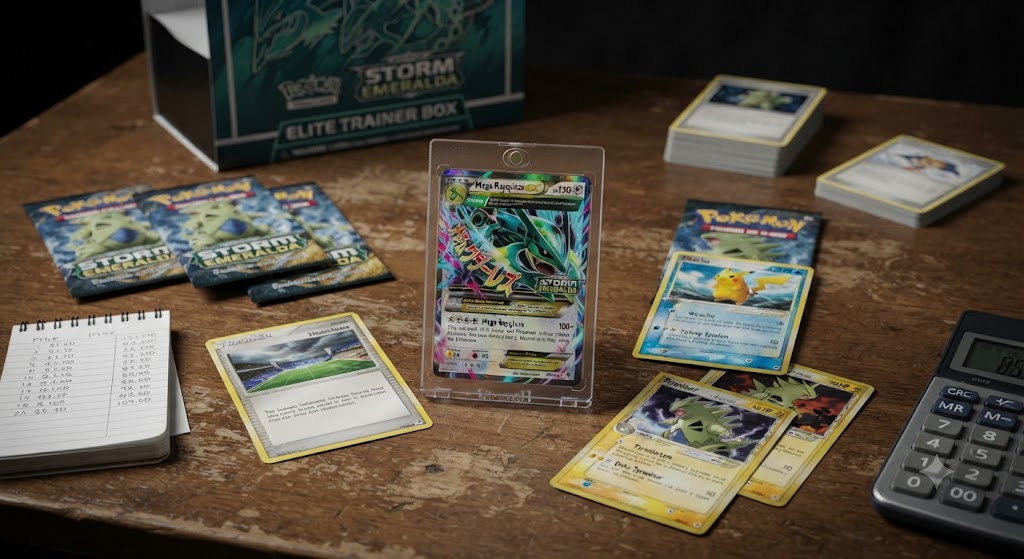
Storm Emeralda hit Japanese shelves on July 31, and the market response has been explosive. Mega Rayquaza ex SAR, the set's chase card, has already traded hands at ¥35,000–50,000 (roughly €210–300) in the first 72 hours. That puts it on pace with Pitch Black's Mega Darkrai ex launch, but with a key difference: Storm Emeralda introduces the "Legendary Summit" split stadium mechanic, which is already reshaping competitive deck construction.
We tracked early sales data across Cardmarket, eBay, and Japanese retailers to map out exactly which cards and products are worth your money. If you're following the English "Delta Reign" release, scheduled for November 6, 2026, this first-week data is your best roadmap for what to expect.
If you're new to the Mega Evolution era, start with our Mega Evolution era guide for context on how these sets fit together.
Set Overview
Storm Emeralda (M6) is the seventh set in the Mega Evolution era and the Japanese-language predecessor to the English Delta Reign release. The set contains approximately 130 cards, including 12 Mega Evolution Pokémon ex and a new mechanic called Legendary Summit, a split stadium card that changes how stadium-based strategies work in competitive play.
Key Set Details
| Detail | Info |
|---|---|
| Japanese Name | Storm Emeralda (M6) |
| English Equivalent | Delta Reign |
| Japanese Release | July 31, 2026 |
| English Release | November 6, 2026 |
| Card Count | ~130 cards |
| Mega Evolutions | 12 Pokémon ex |
| Chase Card | Mega Rayquaza ex SAR |
The headline card is Mega Rayquaza ex, a Dragon/Flying-type with a Mega Wind Storm ability that discards all Special Energy from your opponent's bench when it Mega Evolves. It's the first Mega Rayquaza since Roaring Skies in 2015, and nostalgia is driving significant collector demand.
First-Week Japanese Market Prices
First-week prices below come from Cardmarket, eBay, and Japanese retailers. PokeBeach reported the initial listings:
| Card | Variant | First-Week Price (¥) | Price (€) | Trend |
|---|---|---|---|---|
| Mega Rayquaza ex | SAR (Special Art Rare) | ¥35,000–50,000 | €210–300 | ▲ Strong |
| Mega Rayquaza ex | UR (Ultra Rare) | ¥12,000–18,000 | €72–108 | ▲ Rising |
| Mega Rayquaza ex | SAR (Full Art) | ¥8,000–12,000 | €48–72 | → Stable |
| Mega Groudon ex | SAR | ¥6,000–9,000 | €36–54 | → Stable |
| Mega Kyogre ex | SAR | ¥5,500–8,500 | €33–51 | → Stable |
| Legendary Summit | Stadium (UR) | ¥2,000–3,500 | €12–21 | ▲ Rising |
| Zinnia's Resolve | SIR (Supporter) | ¥1,800–2,800 | €11–17 | → Stable |
| Mega Latias ex | SAR | ¥4,000–6,500 | €24–39 | → Stable |
What These Prices Tell Us
The Mega Rayquaza ex SAR at ¥35,000–50,000 is the clear standout. Based on historical pull rates for SAR-tier cards in Mega Evolution sets, the odds of pulling a specific SAR are roughly 1 in 2,400 packs, or about 16 booster boxes. That makes it roughly comparable to Pitch Black's Mega Darkrai ex SIR in terms of scarcity.
The Legendary Summit stadium at ¥2,000–3,500 is worth watching. Stadium cards rarely command these prices unless they see heavy competitive play. If the card defines a tier-one deck, expect it to climb above ¥5,000 within the first two months.
The Legendary Summit Mechanic: Why It Matters
Storm Emeralda introduces Legendary Summit, a split stadium card with two halves:
- A Legendary Summit card has two halves, and each half occupies one stadium slot
- Both halves must be played by the same player to activate the full effect
- Opponents can disrupt the combo by playing a regular stadium card, which only replaces one half
- When both halves are active, the card grants a powerful global effect (similar to Ace Spec cards)
This mechanic matters for two reasons:
Competitive play: Legendary Summit creates a new archetype. The dual-stadium approach forces opponents to run more stadium removal, from Escape Rope and Field Blower to the new Rayquaza's Roost (from the same set). This shifts the meta away from single-stadium dominance and rewards players who can protect their board state.
Collector value: The mechanic's novelty drives demand for the UR and SAR variants. Collectors know that mechanically unique cards tend to hold value better than reprints or standard abilities. The Legendary Summit UR at ¥2,000–3,500 could be a sleeper buy if the mechanic proves competitively dominant.
Product ROI: What's Worth Opening
Japanese Storm Emeralda products launched with several tiers. Early sales data shows how each tier performs:
| Product | MSRP (¥) | MSRP (€) | Market Price | ROI Assessment |
|---|---|---|---|---|
| Booster Box (30 packs) | ¥4,950 | ~€30 | ¥5,800–6,500 (€35–39) | ▲ +17–31% premium |
| Pokemon Center ETB | ¥6,600 | ~€40 | ¥8,000–9,500 (€48–57) | ▲ +21–42% premium |
| Build & Battle Box | ¥2,750 | ~€17 | ¥3,200–3,800 (€19–23) | → +16–38% premium |
| Booster Pack (single) | ¥165 | ~€1 | ¥200–250 (€1.20–1.50) | ▲ +21–52% premium |
Booster boxes are the sweet spot. At ¥4,950 MSRP, each box guarantees 30 packs with one holo rare or above per pack. The ¥5,800–6,500 market price reflects genuine demand, not speculative inflation. Storm Emeralda boxes are moving fast in Japan.
If you're importing Japanese booster boxes, a dedicated booster box carrying case or sealed product storage box will protect your investment during shipping and long-term storage.
Pokemon Center ETBs carry a premium because they include exclusive promo cards and a higher pack count (12 packs vs. 9 in standard ETBs). If you can get them at MSRP, they're excellent value. At secondary market prices, the math gets tight.
Build & Battle Boxes are your best entry point for sealed collecting. At ¥2,750, the risk-reward is favorable: four packs plus a pre-built deck, and the box art is collectible. We'd recommend these for casual ripping, not investment.
Comparison to Chaos Rising and Pitch Black
Every Mega Evolution era set has followed a similar price trajectory. Storm Emeralda's first week fits the pattern:
| Metric | Chaos Rising (M1) | Pitch Black (M5) | Storm Emeralda (M6) |
|---|---|---|---|
| Chase Card Peak (first week) | ¥42,000 (€252) | ¥55,000 (€330) | ¥50,000 (€300) |
| Booster Box Premium (first week) | +35% | +40% | +17–31% |
| SIR Price Range | ¥8,000–15,000 | ¥15,000–25,000 | ¥8,000–18,000 |
| Competitive Impact | Medium (Tera box) | Low | High (Legendary Summit) |
| Collector Demand | Strong (first set) | Very Strong (Darkrai nostalgia) | Strong (Rayquaza nostalgia) |
The pattern is consistent: first-week premiums are highest when nostalgia meets novelty. Storm Emeralda's Mega Rayquaza ex benefits from both. It's the first Mega Rayquaza in a decade, and the Legendary Summit mechanic is genuinely new.
Pitch Black's Mega Darkrai ex peaked higher (¥55,000) but that was driven partly by MUR scarcity (1 in 3,600 packs). Storm Emeralda doesn't have an ultra-rare tier above SAR, which caps the maximum pull but also means the SAR holds a larger share of collector demand.
If you followed the Pitch Black launch, you'll recognize the playbook: early premiums compress 15–25% in the first month as supply catches up with demand. Storm Emeralda is tracking the same way.
Investment Strategy: What to Buy Now, What to Wait On
Buy Now
- Booster boxes at or near MSRP: if you find Japanese Storm Emeralda boxes at ¥5,500 or less, buy them. The current market supports a ¥5,800–6,500 range, and MSRP stock is disappearing fast.
- Legendary Summit UR at ¥2,000–3,500: this is a speculative buy with upside. If the mechanic proves competitively dominant, the card could double within three months. Even if it doesn't, the floor is around ¥1,500.
- Mega Rayquaza ex UR at ¥12,000–18,000: the UR is more accessible than the SAR and carries strong long-term potential. Rayquaza consistently ranks among the top five most popular Pokémon globally.
Wait 4–6 Weeks
- Mega Rayquaza ex SAR: the ¥35,000–50,000 range will compress as supply enters the market. Based on Chaos Rising and Pitch Black patterns, expect a 15–20% dip by mid-September. Target ¥28,000–40,000 (€168–240) for a better entry.
- All non-flagship SAR singles: Mega Groudon ex, Mega Kyogre ex, Mega Latias ex. First-month premiums on secondary chase cards typically drop 10–20%.
- Pokemon Center ETBs at secondary market prices: only worth it if the promo card is to your taste. The sealed premium is real but tight.
Avoid
- Single packs at ¥200–250: the per-pack premium is too high. You're paying 21–52% over MSRP for a single pack with no guaranteed pull. Buy a box instead.
- Graded cards at current prices: PSA and CGC turnaround times mean you won't see grades for 3–6 months. By then, raw card prices will have settled. Grade only cards you plan to keep.
Pack Opening vs. Buying Singles: The Math
To pull Mega Rayquaza ex SAR from packs:
- Average pull rate: 1 in 2,400 packs (~80 boxes)
- At MSRP (¥4,950/box): ¥396,000 (~€2,376)
- At market (¥6,000/box): ¥480,000 (~€2,880)
- Card value: ¥35,000–50,000 (€210–300)
- Loss: ¥346,000–445,000 (€2,076–2,670)
To pull Legendary Summit UR from packs:
- Average pull rate: 1 in 960 packs (~32 boxes)
- At MSRP: ¥158,400 (~€950)
- At market: ¥192,000 (~€1,152)
- Card value: ¥2,000–3,500 (€12–21)
- Loss: ¥154,900–190,000 (€929–1,140)
The math is unambiguous: buy singles for specific cards. Open packs for the experience.
Pack opening is entertainment, not investment. If you enjoy the thrill of ripping packs, set a budget (one or two boxes) and enjoy it. But if you're chasing a specific card, the single-card market will be cheaper than pulling it yourself.
📊 Track your Storm Emeralda pulls with CardTrezor, the free portfolio tracker with live Cardmarket prices. Start tracking free
Read Next
- Storm Emeralda Preview: Mega Rayquaza ex & Every Chase Card Revealed: Full card list, pull rates, and early price predictions before launch
- Chaos Rising One Month Later: Market Analysis & Price Movements: How the first Mega Evolution set performed post-launch