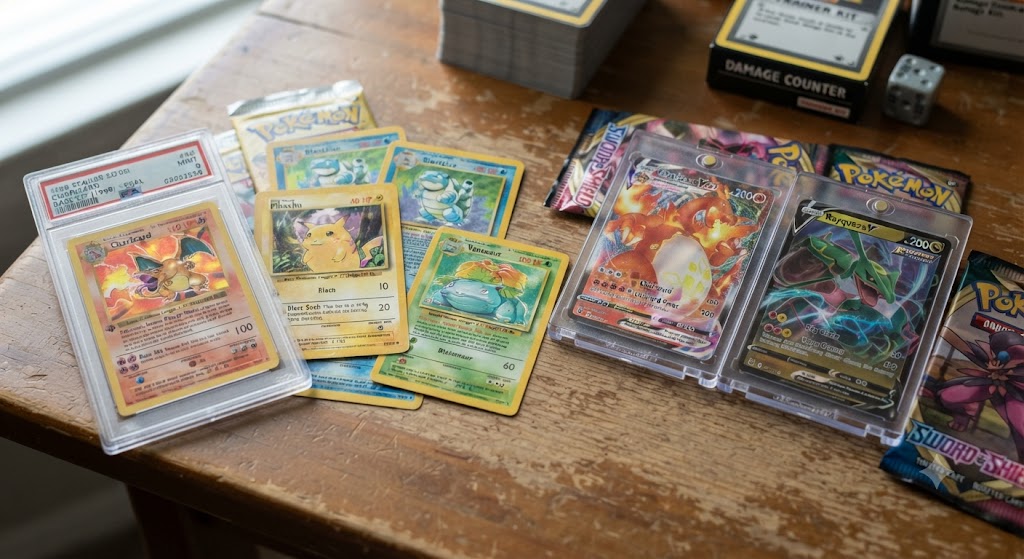
Market experts told you modern cards would catch up to vintage. The 2026 data says otherwise.
For years, the conventional wisdom in Pokémon investing was simple: modern chase cards with their flashy special illustration rares and alternate arts would eventually match the appreciation of vintage Base Set and Neo-era slabs. It made intuitive sense. New sets, new mechanics, new artwork. Surely the next generation of cards would become the collectibles of tomorrow.
Instead, the data tells a completely different story. We analyzed price trajectories across Cardmarket and auction results from the first half of 2026, and the gap between vintage and modern isn't closing. It's widening. Vintage PSA 10 cards are appreciating at nearly four times the rate of modern chase cards, and the structural reasons behind this divergence suggest it's only going to accelerate.
We tracked these numbers week by week. The pattern is clear, and it has direct consequences for your portfolio strategy.
The Numbers: Vintage Crushing Modern
The PKE Market Index shows the trend in plain numbers. From March to June 2026, the index climbed from 100.38 to 120.66, roughly 20% in three months. Summer 2026 is supposed to be a soft season for Pokémon card prices. It isn't. Vintage is the reason.
Weekly Growth Rates: A 4x Gap
The performance difference between vintage and modern is staggering when you look at weekly appreciation:
| Category | Weekly Growth | 3-Month Growth | Top Performer |
|---|---|---|---|
| EN Vintage (PSA 9-10) | +0.86% | +11.2% | Lugia EX #105 (+112%) |
| EN Modern (Chase SIRs) | +0.22% | +2.9% | Gardevoir ex (+43%) |
| Japanese Vintage (PSA 10) | +1.1% | +14.3% | Mew #151 PSA10 (+294%) |
| Mass-Printed Modern | -0.15% | -1.8% | Multiple sets down 20-50% |
Vintage isn't just outperforming modern. It's operating in a different category entirely. The top vintage performers aren't edging out modern by a few percentage points. They're delivering double and triple-digit returns while modern chase cards manage mid-single-digit gains.
The Lugia EX Breakout
Perhaps no card better illustrates the vintage resurgence than PSA 10 Lugia EX #105 from Neo Genesis. After years of steady appreciation, the card broke out to 112% above its prior all-time high in Q2 2026. That's not a gradual climb. It's a structural repricing.
Gengar EX #108 tells a similar story: a full 100% gain that doubled its value. These aren't outlier sales on obscure auction houses. These are repeatable, verifiable transactions on Cardmarket and major auction platforms.
Modern's Best: Solid but Slower
To be fair, modern chase cards aren't losing money. Gardevoir ex special illustration rare is up 43%, and Zekrom ex gained 26%. Those are respectable returns in any market. But when vintage is delivering 112% on Lugia EX and 294% on Japanese Mew #151 PSA 10, "respectable" starts looking like underperformance.
The real problem for modern isn't the chase cards. It's everything else. Many special illustration rares have already cooled 50% from their pandemic-era peaks, and mass-printed products are down 20-50% across the board.
The Supply Overhang Problem
One number should make modern Pokémon card investors uncomfortable: 9.7 billion cards. That's how many cards The Pokémon Company International produced in their latest fiscal year. It represents 18.3% of the entire all-time printed total, produced in a single year.
Why This Matters
The math is unforgiving. When you print 18.3% of your total historical supply in one fiscal year, you're not creating scarcity. You're creating abundance. And abundance is the enemy of appreciation.
Modern cards are overprinted by design. TPCi's strategy is to keep booster packs accessible, prevent sealed product speculation, and maximize distribution. That works for players and casual collectors. It works against anyone hoping their modern chase cards will appreciate like vintage slabs.
A modern card you buy today has a theoretical supply ceiling measured in billions. A vintage card you buy has a fixed supply that only shrinks over time as cards get lost, damaged, or locked away in permanent collections.
The Vintage Supply Equation
Vintage cards from Base Set, Neo, and early EX eras have something modern cards never will: a fixed and declining supply. There are no reprints of 1st Edition Base Set Charizard. The population of PSA 10 copies can only stay the same or decrease (through holders choosing to keep slabs permanently).
This is basic supply and demand economics playing out in real time. Demand for vintage PSA 10s is growing (driven by mainstream attention, the Pikachu Illustrator sale, and CNBC coverage of Pokémon's 1,350% price appreciation since 2020). Supply is fixed and shrinking. The result is predictable: prices go up.
Why Vintage Cards Appreciate Differently
The performance gap between vintage and modern isn't just about supply numbers. It's about fundamental differences in how these two categories function as assets.
Cultural Significance Compounds Over Time
A Base Set Charizard isn't just a card. It's a cultural artifact. It represents the origin story of the Pokémon TCG, the card that made an entire generation fall in love with collecting. That cultural weight increases with time. Documentaries, auction headlines, and viral stories about attic treasure finds all reinforce the cultural significance of these cards.
Modern chase cards, no matter how beautiful the artwork, don't have decades of cultural accumulation behind them. A Gardevoir ex SIR might be a gorgeous card, but it doesn't carry the same nostalgic weight as a Neo Lugia.
The PSA 10 Premium Effect
Grading has created a two-tier market within vintage. The gap between a raw vintage card and its PSA 10 counterpart isn't just about condition. It's about verified scarcity. A PSA 10 vintage card represents a tiny fraction of an already limited supply, and the grading premium compounds as population reports become more transparent.
Investors increasingly understand that the premium for a PSA 10 isn't a cost. It's access to the highest-performing tier of the Pokémon card market.
The Grading Arbitrage Angle
The most compelling ROI play in the current market isn't buying raw cards and hoping they appreciate. It's the grading arbitrage: the massive premium gap between raw and PSA 10.
Consider Ash's Pikachu SM108 promo. A raw copy trades at roughly $30.91. A PSA 10? $557. That's a roughly 1,700% premium for the same card, differentiated only by its condition grade. We see similar dynamics across promo cards, vintage holos, and select modern chase cards.
The smart money isn't just buying vintage. It's buying raw vintage at fair prices, grading selectively, and capturing the spread between raw market value and slabbed PSA 10 prices.
To maximize your grading ROI, invest in proper card handling supplies. Penny sleeves, toploaders, and semi-rigid card holders protect raw cards during storage and submission. A single scratch or corner ding can cost you a full grade point and thousands in value.
 Ultra PRO Toploaders 3x4 for Collectible Cards (100 Pack)Buy on Amazon →
 ProCase Toploader Binder for 324 Toploaders, 9 PocketsBuy on Amazon →
📊 See how your vintage and modern cards perform side-by-side with CardTrezor: the free portfolio tracker with live Cardmarket prices. Start tracking free
What This Means for Your Portfolio
The data points to a clear strategy: vintage is the core, modern is the satellite. We'll say it plainly: at 0.86% weekly growth, vintage PSA 10s are the strongest asset class in Pokémon right now, and we weight our recommendations accordingly. Here's how to structure your allocation.
Core Holdings: PSA 9-10 Vintage
These are your anchor positions. Focus on:
- Base Set holos (Charizard, Blastoise, Venusaur) in PSA 9 or 10
- Neo-era cards (Lugia, Celebi, Umbreon) with strong graded populations
- Expedition and early EX era cards that are entering the "classic" window
These cards have proven track records, established markets, and the supply dynamics that favor long-term appreciation.
Satellite Plays: Modern Chase Cards at Post-Launch Dips
Modern chase cards can still deliver returns when you buy at the right price. The pattern we've observed: special illustration rares typically spike at launch, then cool 20-35% over the following 3-6 months before stabilizing. That stabilization window is your entry point.
Focus on cards with strong competitive play relevance or unique artwork that will age well. Gardevoir, Charizard, and Eeveelution chase cards tend to hold value better than others.
What to Avoid
- Raw modern at premium prices: you're paying for hype, not scarcity
- Mid-tier graded modern (PSA 7-8): these cards face the worst of both worlds: too expensive to be raw, too common to command a premium
- Mass-printed sealed modern product: the 9.7 billion card production volume means these aren't becoming scarce anytime soon
Track It All with CardTrezor
Whether you're building a vintage-heavy portfolio or balancing between eras, having real-time visibility into your holdings matters. CardTrezor gives you live Cardmarket prices across your entire collection, so you can see exactly how your vintage and modern allocations are performing.
Read Next
- The Ultimate Guide to Building a Pokémon Card Investment Portfolio in 2026: Structured approach to portfolio allocation across eras and grades
- How to Predict Pokémon Card Value Fluctuations: Data-driven methods for spotting price movements before they happen