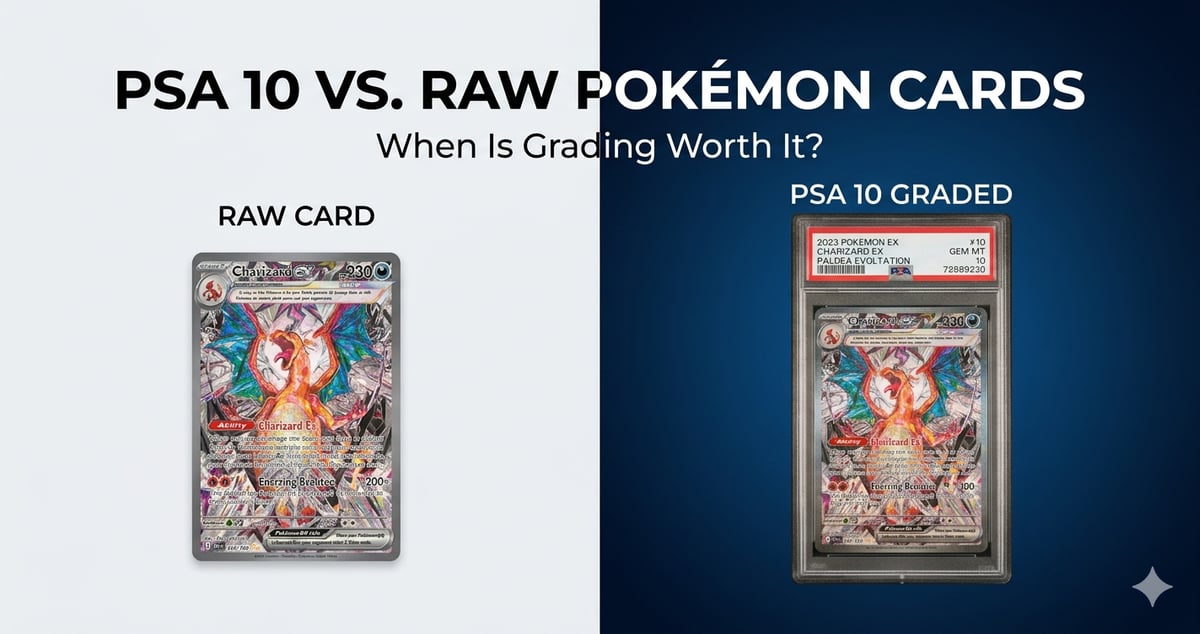
Grading a Pokémon card can multiply its value by 3–10x. Or it can be a complete waste of money.
The difference comes down to one question: does the expected graded value, adjusted for your odds of each grade, beat the raw price plus fees? Too many collectors submit everything hoping for a PSA 10, only to receive a PSA 7 worth less than the grading fee.
This guide lays out the framework we use to decide which cards to grade, which company to send them to, and when to keep them raw.
What Grading Actually Does (And Why It Matters)
The Three Value Drivers of Grading
1. Authentication: A graded card is verified as genuine. For high-value cards, this eliminates counterfeiting risk.
2. Condition standardization: Buyers know exactly what they're getting. A "PSA 9" means the same thing whether you're buying in Berlin, Tokyo, or New York.
3. Preservation: The sealed slab protects the card from further damage, locking in its current condition permanently.
The Price Premium Is Real
Grading shifts card values in predictable steps. A Mega Evolution-era chase card shows the pattern:
| Condition | Approximate Value | Premium vs. Raw |
|---|---|---|
| Raw (NM assumed) | €50 | – |
| PSA 8 | €55 | +10% |
| PSA 9 | €85 | +70% |
| PSA 10 | €180 | +260% |
And for vintage (Base Set Charizard):
| Condition | Approximate Value | Premium vs. Raw NM |
|---|---|---|
| Raw (NM) | €8,000–12,000 | – |
| PSA 7 | €8,500 | ~0% |
| PSA 8 | €15,000–22,000 | +80% |
| PSA 9 | €45,000–65,000 | +400% |
| PSA 10 | €280,000–320,000 | +2,800% |
The premium grows exponentially at the top grades, and so does the difficulty of hitting them.
Grading Companies Compared: PSA vs. BGS vs. CGC vs. PCA
PSA (Professional Sports Authenticator)
Market share: ~65% of Pokémon card grading
Pros:
- Highest liquidity: PSA-graded cards sell fastest
- Largest collector recognition
- Clean, simple labeling
- Strongest price premiums for 10s
Cons:
- Highest prices (starting at €19/card for bulk, €47+ for declared value)
- Longer turnaround times (2–6 months for standard)
- No subgrades (just a single number)
Best for: Cards you plan to sell or trade. The PSA label commands the highest resale premium.
BGS (Beckett Grading Services)
Market share: ~20% of Pokémon card grading
Pros:
- Subgrades (centering, edges, corners, surface), valued by serious investors
- "Black Label" 10 (all four subgrades at 10) commands massive premiums
- Professional, detailed assessment
Cons:
- Lower liquidity than PSA (fewer buyers specifically seek BGS)
- Higher prices than PSA for equivalent services
- BGS 9.5 often sells for less than PSA 10 despite comparable quality
Best for: High-value cards where subgrade detail matters for your collection or for long-term investment documentation.
CGC (Certified Guaranty Company)
Market share: ~12% and growing
Pros:
- Most competitive pricing (starting at €14/card)
- Fastest turnaround times
- Subgrades available
- Growing market acceptance
Cons:
- Lower premiums than PSA for equivalent grades
- Younger brand in Pokémon (established in comics, entered cards in 2020)
- Some collectors perceive CGC as "second tier"
Best for: Budget-conscious grading, cards in the €30–100 raw value range, and authenticating cards you plan to hold.
PCA (Professional Card Authentication)
Market share: Small but significant in Europe
Pros:
- European-based (faster shipping within EU)
- Competitive pricing in euros
- No customs delays for EU residents
Cons:
- Limited international recognition
- Lower resale premiums than PSA/BGS
- Smaller population database
Best for: European collectors who want authentication without international shipping costs and customs complications.
The Math: When Grading Is Profitable
The Break-Even Formula
Grading Profit = (Graded Value × Probability of Grade) − Raw Value − Grading Cost − Shipping Cost
For grading to be profitable, the expected graded value (adjusted for the probability of achieving each grade) must exceed the raw value plus all costs.
Worked Example: Modern Chase Card
Card: Mega Charizard ex SAR from Perfect Order Raw value: €90
Grading costs (PSA standard tier):
- Grading fee: €20
- Shipping to PSA: €15
- Return shipping: €15
- Total cost: €50
Expected outcomes (based on typical modern card centering/quality):
| Grade | Probability | Graded Value | Expected Value |
|---|---|---|---|
| PSA 10 | 40% | €250 | €100 |
| PSA 9 | 45% | €120 | €54 |
| PSA 8 | 10% | €95 | €9.50 |
| PSA 7 or below | 5% | €70 | €3.50 |
| Weighted expected value | €167 |
Profit calculation: €167 − €90 (raw) − €50 (costs) = €27 expected profit
Verdict: Worth grading, but only if you're confident the card is in genuine NM+ condition.
Worked Example: Low-Value Modern Card
Card: Regular holo from a recent set Raw value: €8
Even with a PSA 10, this card might be worth €15–20. After €50 in grading costs, you'd lose €30–35.
Verdict: Skip grading cards with raw values below €40–50 unless they carry significant sentimental value.
Cards You Should Always Consider Grading
1. Vintage WOTC Holos in NM+ Condition
If you have a Base Set, Jungle, Fossil, or Neo-era holo in excellent condition, grading almost always adds value. Even a PSA 7 authenticates the card and provides a price floor.
2. High-Value Chase Cards (€100+ Raw)
The higher the raw value, the more the grading premium amplifies returns. A card worth €200 raw might be worth €600 as a PSA 10.
3. Cards You Plan to Sell at Auction
Auction houses strongly prefer graded cards. The authentication removes buyer risk and typically results in 20–30% higher hammer prices.
4. Cards for Long-Term Investment Holds
If you're holding a card for 5+ years, grading preserves condition and locks in value. The slab protects against accidental damage during storage.
 Ultra PRO Toploaders 3x4 for Collectible Cards (100 Pack)Buy on Amazon →
Cards You Should NOT Grade
1. Common and Uncommon Cards
No matter how perfect the condition, a common card worth €0.50 raw won't justify grading costs.
2. Cards with Visible Damage
If you can see whitening on edges, surface scratches, or centering issues with the naked eye, expect PSA 6–7 at best. The grading premium at these levels rarely justifies the cost.
3. Heavily Printed Modern Cards Worth Under €30 Raw
Modern cards from standard booster packs with high print runs won't command meaningful PSA 10 premiums unless they become competitively relevant or nostalgically significant years later.
4. Cards You Play With
If you use a card in your competitive deck, don't grade it. Graded cards can't be played.
Our stance: grade for liquidity and authentication, not hope. The break-even math above is why we only send cards worth €100+ raw, or cards we plan to sell within a year. Everything else stays in a binder, and the money stays in your pocket.
How to Self-Assess Before Submitting
Before spending money on grading, perform these checks at home:
Centering Check
Hold the card under good lighting and examine the borders:
- Front centering: Are the borders equal on all four sides?
- Back centering: Check the back borders too; many collectors forget this
- PSA 10 standard: Front 55/45 or better, back 75/25 or better
Surface Inspection
Use a light source at a low angle to reveal:
- Scratches (including print lines, which are common on modern cards)
- Fingerprints or smudges
- Indentations or pressure marks
- Holo scratching (on holographic cards)
Edge and Corner Examination
Use a loupe or magnifying glass:
- White spots on colored edges = edge wear
- Soft or rounded corners = corner damage
- Peeling or chipping = significant condition issues
 Jeweler's Loupe 10x with LED Light for Card InspectionBuy on Amazon →
The Honest Assessment
Spot any of the issues above? Downgrade your expected grade by at least 1 point. A card you think is perfect is likely a PSA 9. A card with one minor flaw is likely a PSA 8.
Ready to build your graded card investment portfolio? Read The Ultimate Guide to Building a Pokémon Card Investment Portfolio and learn How to Spot Fake Pokémon Cards before buying raw cards to grade.
Affiliate Disclosure: CardTrezor is a participant in the Amazon EU Associates Programme. We earn from qualifying purchases. This article contains affiliate links.
Read Next
- The Great Divide: Why the Pokémon Card Market Is Splitting in 2026 – The grading premium in a divided market
- Build a €10K Pokémon Portfolio: Free Tracker with Live Cardmarket Prices – Incorporate grading into your strategy